Work with the high-energy channel
Bring fragment evidence into the HDX review instead of treating the experiment as MS1 data alone.

For Waters HDX-MS labs
Waters HDMSe acquisitions contain more than peptide-level MS1 measurements. HDX Workbench uses ion mobility to help disentangle the shared elevated-energy fragments. Review MS2 fragment-derived deuterium uptake alongside MS1 peptide measurements and inspect the evidence behind each HDX result.
Bring a representative dataset. We also offer a 30-day software trial.
This example shows Waters HDMSE fragment deuteration alongside precursor measurements in one sequence view. The 105 amino acid sequence matches horse Cytochrome C (Equus caballus; UniProt P00004).
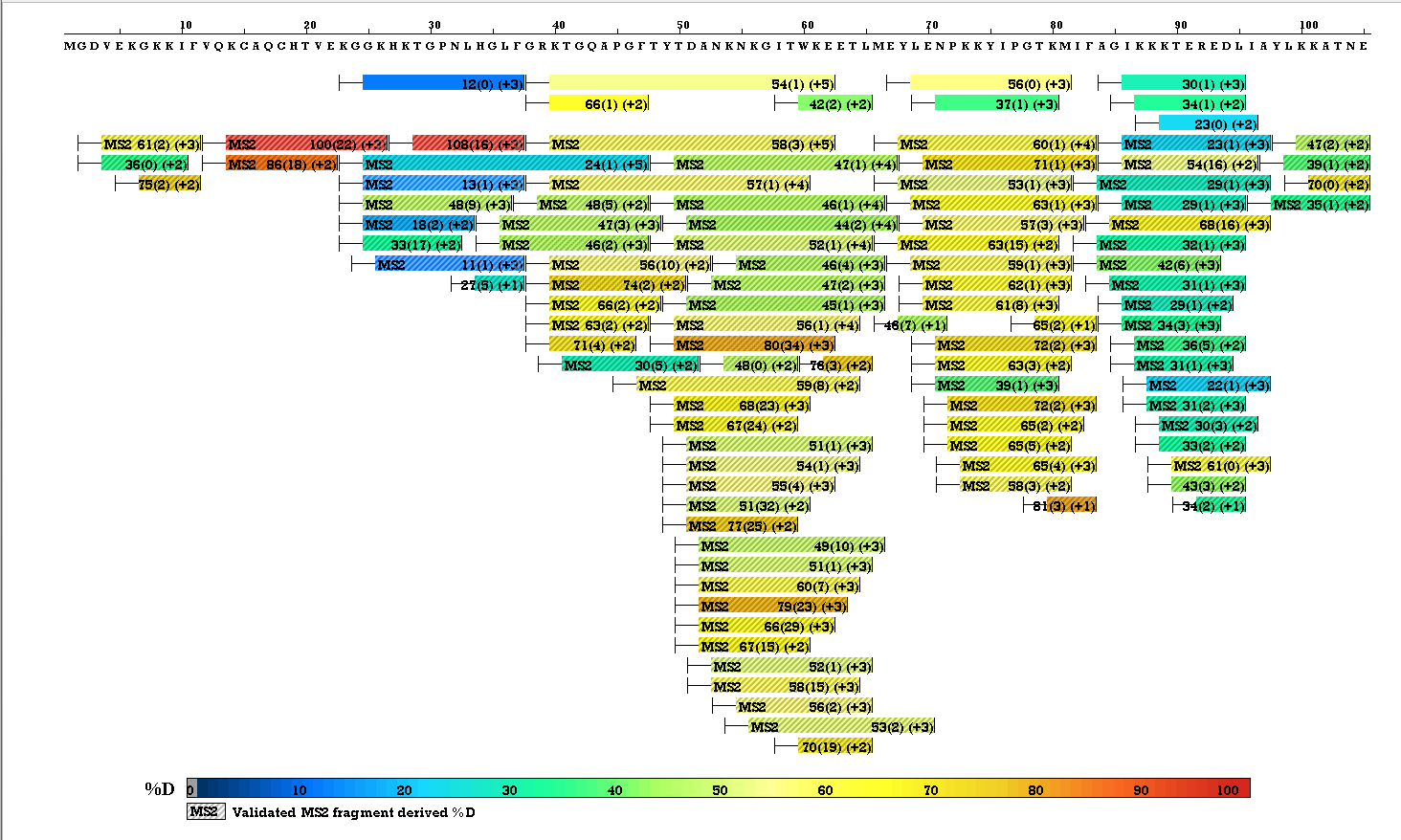
HDMSᴱ acquires low-energy precursor information and elevated-energy fragment information without precursor m/z isolation windows. The elevated-energy channel mixes fragments from co-eluting peptides; ion mobility adds a separation dimension that can help resolve those mixtures.
Bring fragment evidence into the HDX review instead of treating the experiment as MS1 data alone.
Ion mobility-assisted HDX-MS fragment analysis helps distinguish signals that share chromatographic time and crowded spectra.
Inspect precursor and fragment evidence together as you evaluate peptide assignments and deuterium uptake.
The workflow starts with the data your Waters system already records. HDMSᴱ is data independent in the broad sense, but it does not use the m/z isolation windows of conventional windowed DIA.
Record low- and elevated-energy functions with ion mobility enabled.
Use chromatographic time, mass and ion-mobility drift time to evaluate HDMSE precursor–fragment alignment in the shared elevated-energy channel.
Inspect peptide measurements with the available supporting fragment information.
Move from a result to the spectra and chromatograms behind it.
No windowed DIA method required. This page is about Waters HDMSᴱ data: a shared elevated-energy fragment channel plus ion mobility, analyzed in the context of your HDX experiment.
The fastest way to judge this capability is to follow one peptide from the acquisition through the analysis.
In a guided demo, we can walk through a representative HDMSᴱ experiment and show:
Tell us your Waters instrument model, acquisition mode and a brief description of the experiment. We will confirm compatibility before asking you to prepare data.
A Waters HDMSᴱ review
Schematic of the evidence reviewed in an HDMSᴱ analysis.
HDMSᴱ data and windowed DIA data are different acquisition types. We discuss them separately so the required input and the meaning of fragment evidence stay clear.
Compatibility depends on the instrument, raw-file format and acquisition settings. Send us those details and we will check your specific workflow.
Fragment signals can provide evidence for peptide identity and deuterium measurements. Interpretation of spatial resolution depends on the fragmentation method, scrambling and experimental controls; CID fragments alone do not establish single-residue HDX resolution.
If your lab uses Waters DynamX in an HDMSE workflow, bring a representative dataset for a guided review of the MS1 peptide results and the MS2 fragment-derived deuteration shown in the Horse Cytochrome C example. We will show what HDX Workbench extracts from your existing acquisition and check compatibility with your instrument and files.
Request a guided Waters data demo or a 30-day HDX Workbench trial. We will start by checking the acquisition details and the question you want the analysis to answer.